Hakken · Mergers & acquisitions
Know what you’re buying before you close.
Hakken reads an acquisition target’s estate and reports what is running on it: what depends on what, what has to move first, and what will block it. Every answer carries the evidence behind it.
You’re buying infrastructure nobody has described to you.
Technical due diligence is usually a document exercise. You get an asset register that’s two years stale, an architecture diagram somebody drew for a board pack, and a management team with every reason to be optimistic.
Then you close. At integration the truth arrives: the dependency nobody documented, the database running on an operating system that lost support three years ago, the licence position that rewrites your deal model. That is the expensive moment to find out. The price is agreed, and the remediation is yours.
What the report tells you.
Hakken produces a report, not a pile of data:
- What is there. Hosts, the operating systems and software on them, the services they run, and the traffic between them.
- What depends on what. Which systems have to move together, and in what order.
- What you are inheriting. Software past end of support, known vulnerabilities per host, gaps in security agent coverage, and where licence exposure sits.
- What to do first. A suggested migration sequence, and the findings that block each step.
Each finding carries how confident Hakken is in it and the evidence it rests on, so you can see which conclusions are solid and which are inference.
You probably can’t put software on a seller’s network. You don’t have to.
This is the practical obstacle in every deal: before signing, a seller is rarely going to let the buyer’s tooling touch production. Hakken is built for that, with three ways in.
- The target’s own team runs it. They run a single command on their own machines and hand back a sealed file. Nothing of yours touches their network, and nothing of theirs is installed or left behind. Hakken checks the seal on the way in, so what you analyse is provably what they produced.
- Whatever they have already exported. A case with nothing in it but the target’s own spreadsheet still produces a report, and that report states plainly how little it rests on.
- Credentialed collection, when you have access. After signing, or where the seller agrees, Hakken reads the estate directly over the services the hosts already run.
The routes mix, and each produces the same kind of report. What changes is how much it can say, and every fact in it records which route produced it.
Three things that make the answer defensible.
It reports what it couldn’t see, before it reports any finding.
The second section of every Hakken report is the coverage gaps: the hosts it couldn’t reach, the checks it lacked the access to run, and what that means for everything that follows. A report that hides what it missed will embarrass you in committee.
It works with partial access and a deadline.
Hakken expects the real situation: an undocumented network, credentials that only half work, and a date. Each part degrades instead of failing. A host it can only see from the outside still appears, marked as a gap. A check it can’t run records why it couldn’t.
Every fact can be traced.
Each one records where it came from, how it was read, when, and with what level of access. Operator actions go into a running record that can’t be quietly edited afterward, and each report is stamped so it can be matched to the exact data it was generated from. When someone asks “how do you know that”, there’s an answer.
What the report actually looks like.
Three views from a real Hakken run, start to finish: generate the estate, collect it, verify every signature, analyse it offline, render the report.
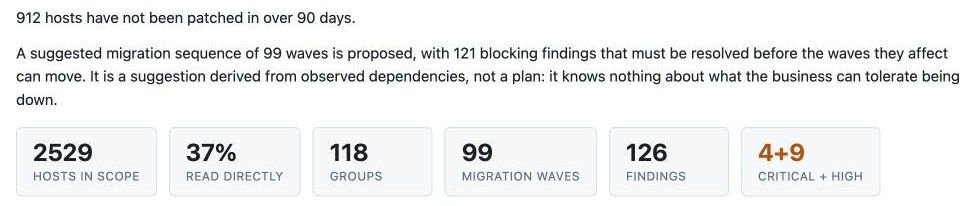
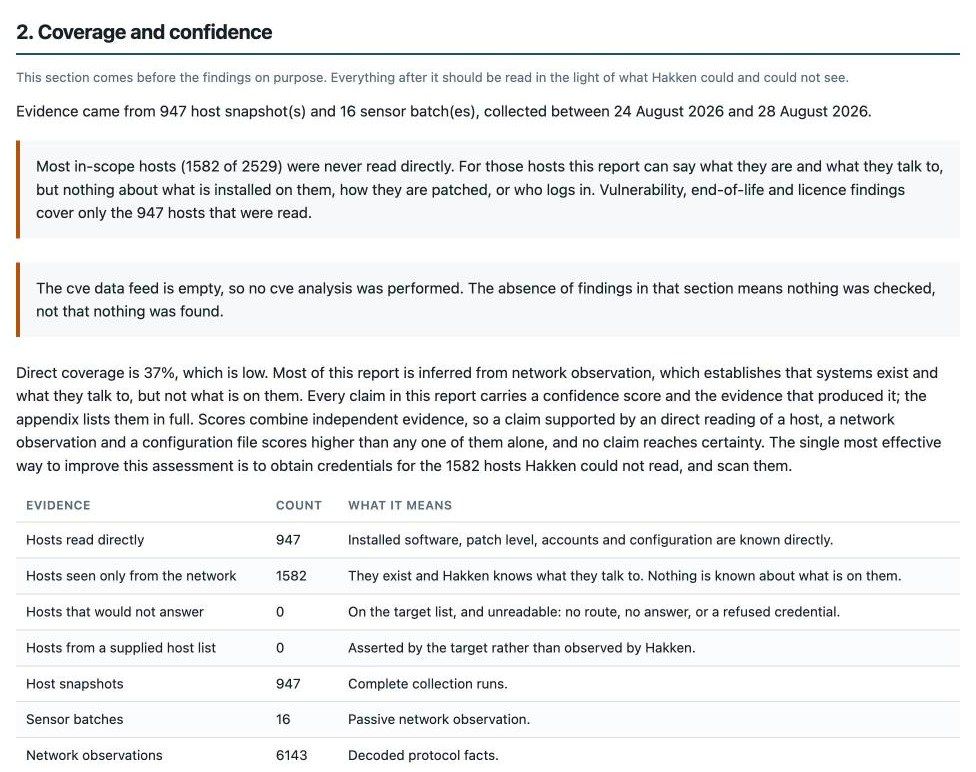
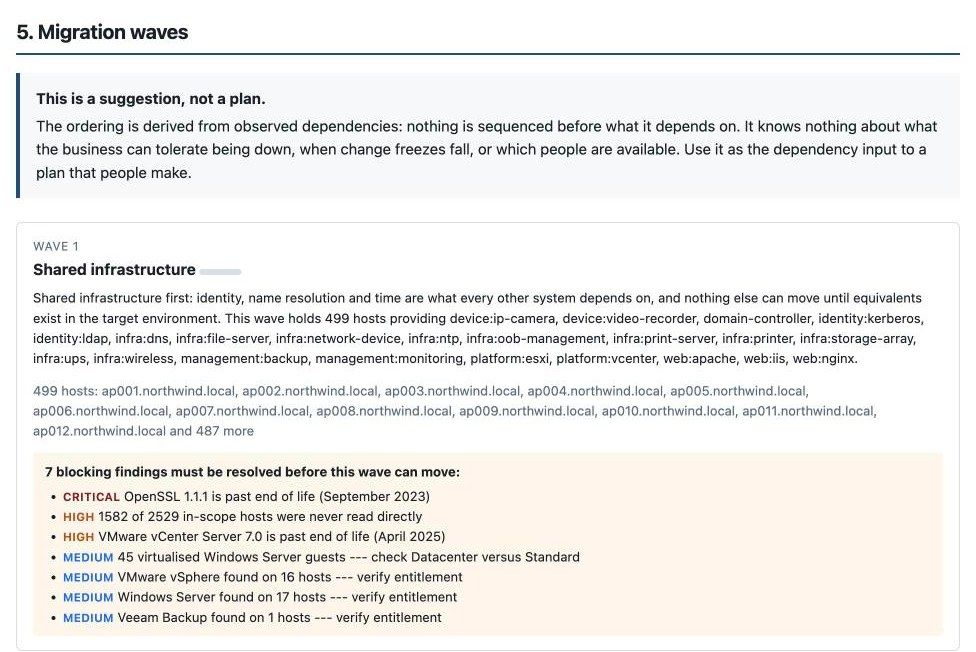
Northwind Manufacturing is a generated estate, not a customer. Hakken ships with it so a whole engagement can be run end to end with no network and no target system, through the same collection, verification, analysis and reporting path a real one uses. We are happy to run it in front of you.
Software your team runs. Nothing left behind.
Hakken is a product you run, inside your own infrastructure or on a laptop. There is no service of ours in the loop and no data sent anywhere. The “operator” in the documentation is your person, or the target’s.
Where it connects to a machine, it goes over a service that machine already runs: SSH on Linux, WinRM or OpenSSH on Windows. It reads, then disconnects. Nothing is installed on any target host: no agent, no service, no scheduled task, no files left behind.
It can also read a copy of network traffic from a mirror port you set up, which is how dependencies nobody documented turn up. Analysis and reporting need no network at all, so Hakken works inside segments that have no route out.
Three things it deliberately does not do, because they are the reason the output is worth anything in a committee room:
- No AI-written narrative. A story that can’t be traced to specific evidence is worthless when challenged, and anything needing a hosted model can’t run inside a network with no internet.
- No telemetry. Nothing about the estate reaches us.
- No offensive capability. No exploitation, no credential harvesting, no evading detection.
Hakken (発見) is Japanese for discovery.
The target’s security team is going to ask.
Hakken is read-only. Its collectors have no path that writes a file, restarts a process, or changes a setting on a machine they read. It does not read secrets: passwords, key material, or the contents of credential files. It runs only the commands on a list we publish and hand over before anything connects. Active network probing ships switched off, and turning it on takes a written scope and an explicit statement that you have authorisation.
Before anything connects, we can hand their team the complete list of what gets read, over what connection, at what privilege, on each platform. Also the scoped read-only account to create, permission by permission, and our own threat model with the risks we think remain.
Tell us about the deal.
The target, the access you expect to have, and the date you are working to. If Hakken fits, we will say so. If it does not, we will say that.
Book a call